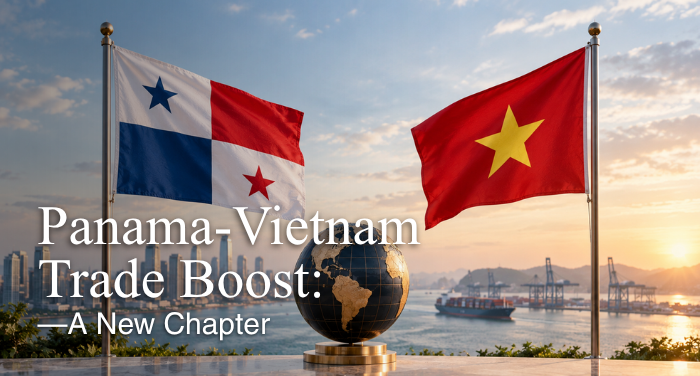
Panama’s appeal as a business base depends on what companies can do from here: reach customers, move products, and manage operations across borders. Its renewed relationship with Vietnam puts that proposition back in focus.
At their meeting in Hanoi, the two governments announced nine cooperation agreements and instruments covering several areas of economic and institutional activity. For readers watching Panama’s development, the question is how those commitments could turn into business activity on the ground.
A trading relationship with room to develop
Bilateral trade between Vietnam and Panama reached $478.1 million in 2025, according to figures from the Vietnamese government reported by ECO TV and EFE. While this figure provides a useful indication of the current trade relationship, it represents trade only and does not account for the total investment entering Panama.
The countries have maintained diplomatic relations since 1975. This latest initiative builds on an established connection, with an emphasis on creating more opportunities for commerce and cooperation.
For businesses, the next step is practical. Will the agreements make it easier to exchange information, navigate procedures, or establish working relationships? Those improvements could matter as much as the announcement itself.
What the agreements actually cover
Panama’s Presidency reported nine agreements and memoranda in its announcement of the presidential meeting. Areas included agricultural cooperation, maritime education, customs, tourism, aviation, diplomatic training and security.
These subjects address different parts of the business environment. Customs cooperation may be relevant to moving goods. Maritime education can support professional skills. Tourism and aviation cooperation could create a framework for further collaboration.
The distinction between a framework and an operating result matters. A memorandum does not establish that a new airline service is running, a development has been financed or a company has committed to opening an office.
The commercial significance will become clearer through implementation: the programs launched, the businesses participating and the obstacles resolved.
Panama’s gateway proposition
The strategic fit is straightforward. Vietnam wants broader access to Latin American markets, while Panama is promoting its Canal, ports, free zones and services as a platform for that access.
Panama’s value in this relationship goes beyond handling a shipment. A regional operation may also need banking, legal support, administration and a place for its people to work. That combination gives the gateway concept a wider commercial meaning.
The Colon Free Zone is one area to watch as the relationship develops. Its relevance should be assessed through actual business engagement and operating requirements, rather than assuming that diplomatic interest will immediately produce new investment.
For a Vietnamese business evaluating Panama, the decision will ultimately depend on costs, customers, procedures and the advantages of serving the region from a Panamanian base.
An embassy reopening would support continuity
Vietnam announced plans to reopen its embassy in Panama in early 2027. That remains an announced plan, rather than a completed reopening.
A permanent diplomatic presence could help sustain contact between institutions and support the longer process of developing commercial relationships. Its value would lie in continuity after the official visit ends.
A new real estate connection with Vietnam
Sotheby’s International Realty announced the opening of Vietnam Sotheby’s International Realty on July 29, 2026. Headquartered in Ho Chi Minh City, the company represents selected luxury homes and residential developments nationwide. It is led by co-founder and CEO Chloe Dang and co-founder and chairman James Miles-Lambert.
For Panama Sotheby’s International Realty, this adds a local counterpart in Vietnam within the same international network. That presence offers a potential channel for introductions and local market insight as clients consider property interests across borders. Alongside the wider diplomatic and trade relationship, it gives the Vietnam connection a practical real estate dimension, although the opening is a separate business development and does not establish investment flows between the two countries.
What this could mean for Panama City
For Panama City’s property market, the potential connection is through people and operating activity. If closer ties lead companies to establish a local presence, those businesses may need offices, temporary accommodation or homes for employees.
“The opportunity for Panama is to turn international connections into businesses that choose to operate here. For property buyers, the signal to watch is sustained local activity: where companies establish themselves and where their people need to live,” said Jeff Barton, Managing Director of Panama Sotheby’s International Realty.
That is a possible channel of demand, not a forecast that the agreements will raise property prices or rental yields.
Residential buyers and owners should keep the wider story in perspective. A particular property still needs to be assessed on its location, competing supply, building condition, ownership costs and realistic rental prospects.
The useful question is whether expanding business relationships produce sustained activity in the neighborhoods and market segments relevant to a purchase. A national announcement alone cannot answer it.
What to watch next
The indicators worth following are concrete: implementation of the cooperation programs, progress toward the embassy reopening, company decisions to establish operations, and future trade data measured on a comparable basis.
It will also matter whether business engagement creates an ongoing local presence or remains limited to occasional visits and transactions. Those outcomes carry different implications for services, employment and property demand.
Panama and Vietnam have set out a broader agenda for cooperation. Its significance for Panama will depend on how effectively institutions and businesses convert that agenda into working relationships. For anyone considering the country as a business base or a place to own property, that progress is worth watching with interest—and assessing through evidence.